
Deep, small muscles keep your joints steady while bigger muscles push and pull. Here is why free-body movement does what machines cannot.
Stabiliser muscles — sometimes called local or core-stabilising muscles — are not the ones you see in the mirror. They sit close to joints and spine, firing in milliseconds to control micro-movements before larger muscles generate power. The transverse abdominis wraps your midsection like a corset. The multifidus runs along your vertebrae. The gluteus medius sits on the outer hip. The rotator cuff quartet centres your shoulder in its socket.
On a leg-press machine, the sled tracks in a straight line. Your body does not need to balance or correct side-to-side drift — so those deep muscles can stay relatively quiet. Remove the machine and stand on one leg: suddenly your gluteus medius must contract hard to stop your pelvis dropping, your ankle invertors and evertors make constant micro-adjustments, and your core stiffens to keep your torso upright. That is the stabiliser system doing its job.
A 2016 review in Sports Medicine noted that free-weight and bodyweight exercises consistently produce greater neuromuscular demand for trunk and hip stabilisers than machine-based equivalents at similar loads. The trade-off is worth it for functional strength — the kind that helps you on uneven ground, stairs, and during everyday tasks.
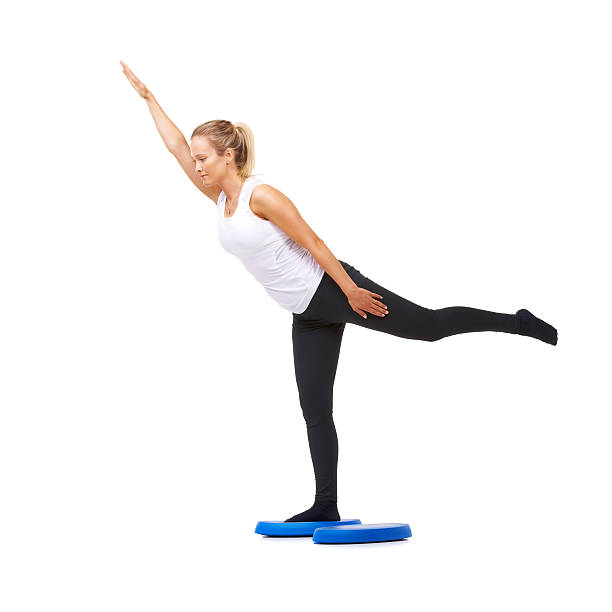
Each example below challenges a specific stabiliser group. Start with the easier version and progress over weeks.
From hands and knees, extend opposite arm and leg while keeping your lower back flat — no sagging or arching. Hold two to three seconds. The challenge is not the reach; it is preventing your trunk from rotating. Research by McGill and colleagues has used this pattern to measure trunk stability endurance in clinical settings.
Stand on one leg, hinge at the hip with a soft knee, and reach toward the floor. Your standing hip must stay level — if it drops, your gluteus medius is not keeping up. Use a wall for fingertip balance at first, then remove the support.
From a downward-dog position, bend elbows and lower your head toward the floor between your hands. The serratus anterior protracts your shoulder blades at the top — think of pushing the floor away. This is the same muscle group that often weakens in desk workers.
Support yourself on one forearm, stack feet, and lift your hips so your body forms a straight line. Lower slowly without collapsing. Add a top-leg lift for extra medius demand. Keep your top shoulder stacked over the bottom — no rolling forward.
On hands and toes with knees hovering just off the floor, crawl forward and backward in small steps. Your entire stabiliser network — shoulders, trunk, hips — must co-contract to stop you wobbling. Move slowly; speed hides instability.
Gym machines are brilliant for isolating large muscle groups under heavy load in a controlled environment. A seated row machine lets you target lats without worrying about lower-back position because the pad supports your chest. That support is exactly what reduces stabiliser recruitment. Your erector spinae and deep core do not need to work as hard to maintain posture.
Bodyweight training inverts this logic. A bent-over row using a towel wedged in a door requires you to hinge at the hips, brace your trunk, and pull — all while your stabilisers fight rotation. The load may be lower, but the neuromuscular complexity is higher. Over time, this complexity translates into better joint control during unpredictable real-world movements.
In our masterclasses we pair machine-free progressions with clear coaching cues so you feel which muscles are working rather than guessing. That sensory feedback is part of how stabiliser strength actually builds.
Stabiliser-focused work often looks gentle but asks a lot of small tissues. Respect the process.
Adding balance or single-leg work too quickly can overload tendons before muscles adapt. Increase hold times by two to three seconds per week, not minutes.
Carpet or a thin exercise mat provides grip. Avoid socks on polished floors for single-leg work. Clear the area of furniture corners.
| Date | Session | Focus |
|---|---|---|
| 21 June 2026 | Core & Stability Lab | Stabiliser progressions |
| 28 June 2026 | Household Fitness Workshop | Towel & chair drills |
| 19 July 2026 | Single-Leg Strength Clinic | Hip & ankle stability |
Many people feel more steady on one leg within three to four weeks of consistent practice (two to three sessions per week). Visible muscle changes take longer. Focus on control quality, not speed.
Light activation drills like dead bugs can be done daily. Heavier single-leg or crawling work benefits from rest days. Alternate hard and easy days to let connective tissue adapt.
They can complement bodyweight training for building raw strength in large muscles. We recommend balancing both — machines for load, bodyweight for control and stability.